It’s not the critic who counts; not the man who points out how the strong man stumbles, or where the doer of deeds could have done them better.
The credit belongs to the man who is actually in the aren, whose face is marred by dust and sweat and blood; who strives valiantly; who errs, who comes short again and again,
Because there is no effort without error and shortcoming; but who does actually strive to do the deeds; who knows great enthusiasms, the great devotions; who spends himself in a worthy cause;
Who at the best knows in the end the triumph of high achievement, and who at the worst, if he fails, at least fails while daring greatly….”
–Theodore Roosevelt, ”Daring Greatly” Brené Brown, pg. 251
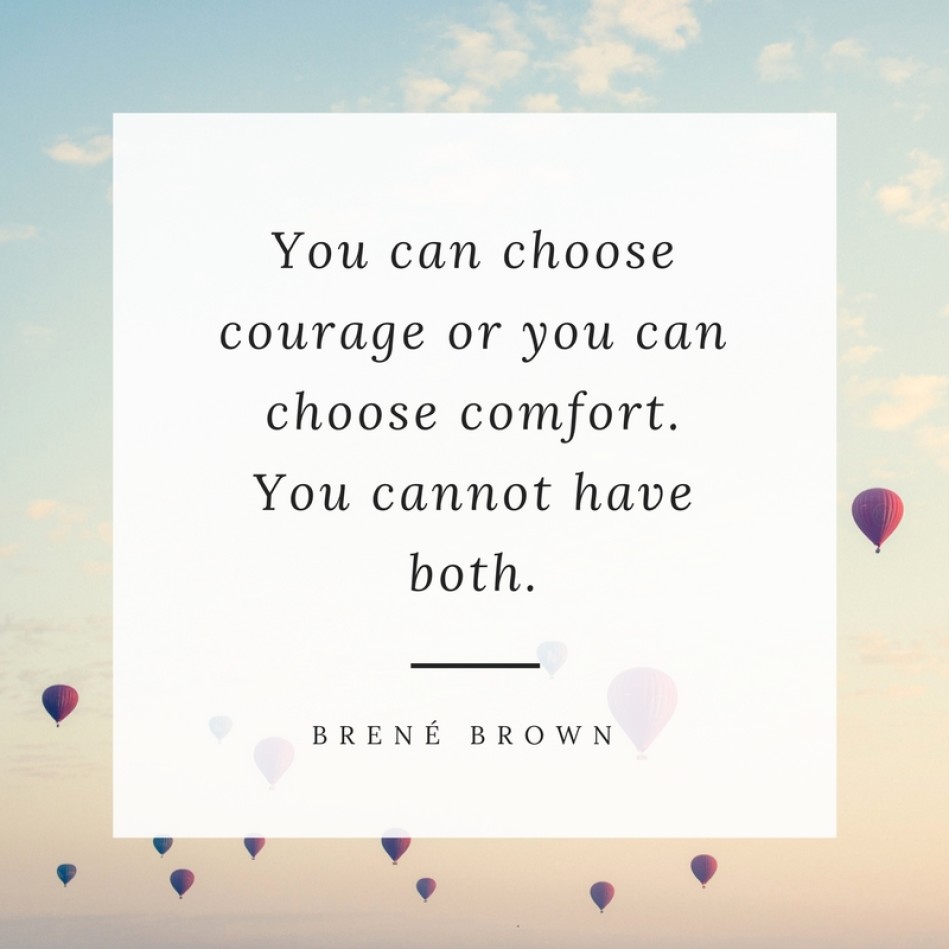
I’ve been a fan of Brené Brown and have just finished “Daring Greatly”. She’s coming to Austin this Fall for the Women’s conference. Managed to snag a ticket literally as I was being hooked up for my second round of chemo. I was not going to miss it! The hook is talking about things that we as a society don’t normally talk about.
”Sometimes the bravest and most important thing you can do is just show up”, Brown, 243. So here I am showing up and reveiling the (wo)man behind the curtain. To do so we must open ourselves up and be vulnerable.
What does it it mean to shed our armor and be vulnerable? To reveal the truth behind our struggles and triumphs. An underlying theme of many of the self-help, personal growth, and leadership books is the idea of being authentic. By being your authentic self you’re more approachable and don’t need to ‘put on an act’ or to be invisible. Most of us want to appear perfect and be Superwoman/Superman. We can do it all, balance everything. What is reality though and why is there still disappointment and shame when we don’t live up to these false expectations?
Laying it all on the line. Taking the plunge. Putting it all out there. What’s the worst that can happen? Well if you’re most people a million reasons immediately flood your mind. It’s easier to stay safe and blend in than be bold and take a risk. Why does fear hold back so much risk and reward? Do folks not like change so much that the status quo is a much safer option? Or is the real fear that it may be rejected or not good enough?
There needs to be a strong drive and reason to challenge your own preconceptions and take that plunge. I guess that’s what I’m starting to do right now. I’m laying out my experiences so others can learn from them and know that they are not alone. Is it scary? A bit, but what’s the alternative that lots of people around the world believe that they too are alone or no one understands what they’re going through?
As a personal example, I was bad at math throughout school. Even that last sentence is wrong, I was told again and again I was bad at math. I felt shame at never grasping the concept fast enough, not knowing the answers when the teacher called on me, or failing test after test. My teachers were content with me barely passing with a C. This is partly due to the special-ed label and being a girl that I’ll get on that soap box another time. Math was a perceived weakness of mine and I needed to spend multiple hours working problems on a 8×10 dry erase board I had hung up in my room. Next to the NSync poster of course. It needed to become my strength. I needed to be better and prove everyone wrong. I hated the struggle and the humiliation of not being good enough. So what did I do? I insisted on taking the most advanced math classes (barely scraping by), getting a Bachelor of Science in Mathematics from the University of Texas at Austin, taught math to students in grades 7-12, and later went on to earn two masters in ed action and lead mathematics for a school district. 20 years ago no one would have thought or expected this. There were no expectations from the school. So why did I do it?
One I wanted to prove the teachers/counselors/principals/speech therapists/classmates who told me that I wasn’t smart enough and that I could do it, that I actually could and did. Secondly I knew that humiliation and shame of being a second class student and being labeled as special ed in the 80s and 90s. Teachers lowered their expectations and the group of us-no matter the labeled disability everyone was seen as incapable. I wanted to help all students not struggle the way I did. To not let their label dictate their perceived opportunities in life. By struggling myself I knew how to break down the concepts and make it easier for others. I had developed empathy and would be the school advocate I never had.
“Compassion is not a relationship between the healer and the wounded. It’s a relationship between equals. Only when we know our own darkness we’ll can be be present with the darkness of others. Compassion becomes real when we recognize our shared humanity” Pemba Chodron.
Proving people wrong, those who have told you that you can’t do something is fun-I’ll admit that. But when does it become enough? How much do you have to prove to them and yourself? It’s a monster that grows. One day you may realize you never had to prove anything to anyone. Would it all have been worth it? What if you did something not to prove it to anyone including yourself but just because you wanted to?
A few random thoughts as I finish up this book and go on to the next.




 Courageous Perseverance